
Skill Tree Guide
Choose a branch by the problem in front of you instead of following an unsupported tier list.
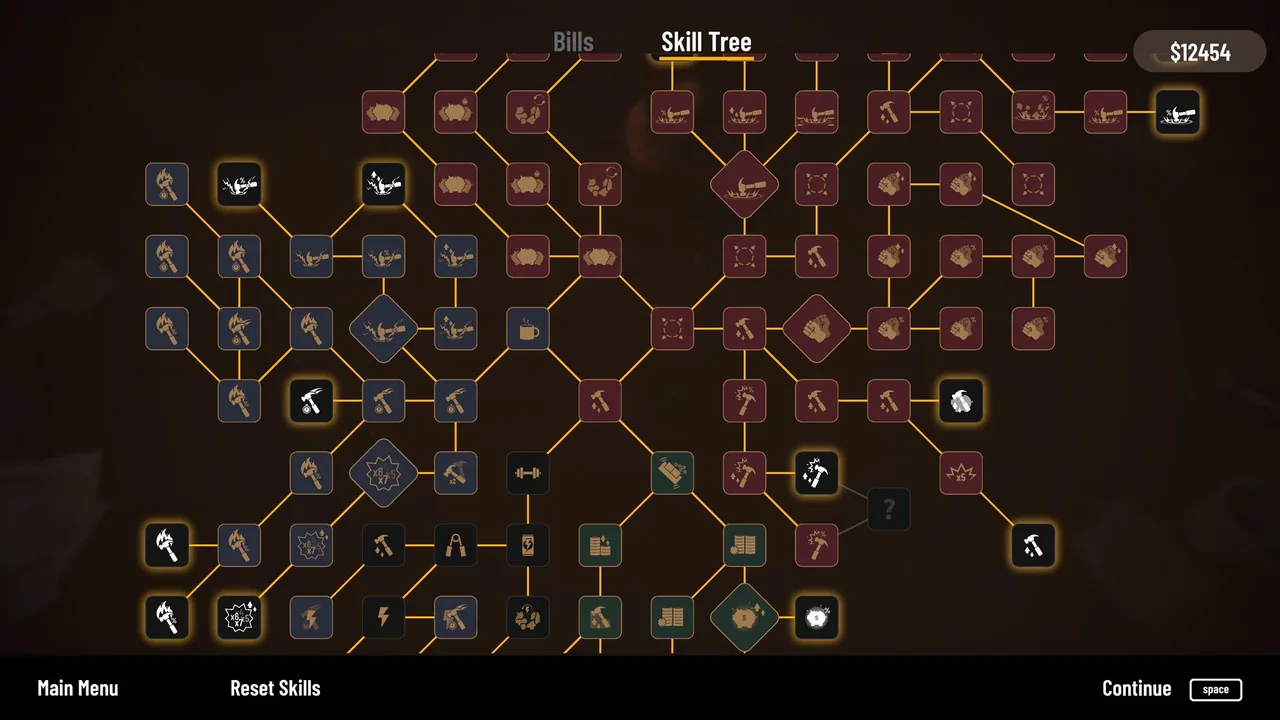
Table of contents
Choose a branch by the limiting problem
The skill tree has multiple paths. The useful first question is not “which node is strongest?” but “what is stopping this run?”
Verified branch map
| If the problem is… | Start by reading… | Verified direction |
|---|---|---|
| Too many hits per piggy | Grip strength | Hit harder |
| Too little stamina or recovery | Caffeine addiction | More stamina and faster recovery |
| Stamina disappears too quickly | Gym training | Slower stamina drain |
| Swings feel too slow | Wrist enhancement | Faster swings |
| Rare piggies are the goal | Luck | Rare piggies appear more often |
| Dense groups need area pressure | Hammer electrification | Electric hits chain between nearby piggies |
The Skill Branch Database lets you search this map by affected system.
Why this is not a best-build list
Node prices, levels, current balance and the rest of a build change the value of an upgrade. A screenshot of the tree shows breadth, not a reproducible ranking. Without comparable current values, a numbered tier list would be an opinion dressed as a database.
A repeatable choice loop
- Name the limiting problem from the last run.
- Choose the branch whose described effect addresses that problem.
- Record a run before and after the change.
- Compare the same derived metric, such as income per stamina.
- Keep or reconsider the direction based on your results.
The Run Comparison Tool supports step four. If the constraint is a hammer tradeoff instead, open the Hammer Database to separate damage, speed, critical chance and radius.
Related guides
Skill Branch Database
Search the verified branches for damage, stamina, slower drain, swing speed, luck, and electric chaining.
Read guideStamina Management Guide
Understand stamina drain, run endings, the Tourist interaction, and what to measure in your own sessions.
Read guideHammer Database: Verified Stats
Compare damage, swing speed, critical chance, and hit radius—the hammer dimensions that can be verified.
Read guide